 |
February 2006
In July 2000, an Air France Concorde crashed just minutes after
takeoff from Paris en route to New York, killing all 109 people on board and
four on the ground.
Two years later, a report published by Air France's Accident Investigation
Bureau (BEA) confirmed that FOD (Foreign Object Debris) in the form of a 40cm
piece of metal had caused the tragedy.
|
|
|
|
|
|
It's hard to believe that something so simple could cause such a disaster.
Yet, FOD on airport runways causes about US$4bn damage to aircraft every
year.
Because of high kinetic energy levels on active runways, FOD can lead
to severe consequences, causing potential loss of the aircraft and on
extremely rare occasions, such as the abovementioned Concorde disaster,
loss of life.
At airports, especially those that cater for jets, runway debris can
come from jet blast effects, eg an aircraft turning from an active runway
onto a narrow taxiway can blow material from the shoulders and in-field
areas backwards onto the runway. Items may also fall from aircraft or
other vehicles, causing a hazard for subsequent users of the runway. Debris can take many forms: nuts and bolts, pavement fragments, washers,
rivets, stones, sand and gravel, metal tools, aircraft parts and drink
bottles, even birds and animals. All are hazardous to aircraft and need
to be removed as quickly as possible.
|
|
| |
|
 |
|
But an airport's best defence against FOD is good housekeeping.
Where debris detection is concerned, there are at least three
stakeholders: the operations people who actually perform the sweeps of
the runway; the pilots who use the runway and the air traffic control
operators responsible for coordinating runway use.
Off the runway there are other 'players' involved in debris control,
such as baggage handlers, catering services and construction workers;
they should be made very aware of the need for good housekeeping. After
all, the best defence against debris on the pavement is to ensure that
it doesn't get there in the first place. If the right precautions are
taken, foreign objects on the active runway are likely to be debris
from aircraft.
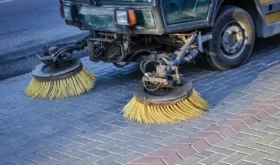
At present FOD is controlled by observation and sweeping activities.
However, the area where the risk is greatest - the active runway of a
busy airport - cannot be swept on a periodic and frequent basis without
reducing the number of aircraft movements.
What is required is an on-condition runway maintenance concept.
Periodic sweeping activities would be less frequent and the runway
would be continuously monitored by automatic sensors to warn of the
appearance of significant pieces of debris. A cost-effective means of
automatically and non-intrusively detecting debris on runways will
reduce safety risk and aid airport operators to maintain an expeditious
flow of traffic. Of course, operations will still be interrupted when
objects are detected, because it will be necessary to retrieve them.
Sydney Airport Radar System Trial
Sydney
Airport, which handles 26 million passengers a year, at the end of last
year (2005) trialled a runway debris radar system developed by UK-based
company QinetiQ. Known as Tarsier, the system can detect small items of
potentially dangerous debris on airport runways. QinetiQ was asked to
develop the system after the Air France Concorde disaster in 2000. Representatives from various organisations, including Melbourne,
Perth, Gold Coast and Auckland airports, Qantas and CASA, were also
present at the Sydney trials.
|
|
|
Sydney Airport Manager Frank
Mondello welcomed the trial and said that safety, including prevention
of aircraft damage from runway debris, was a major issue.
"While our safety record is excellent, we are conscious of the need to
maintain and improve standards, particularly where new technology is available," Mondello
says.
The system, based on high-resolution millimetre wave radar, is able to
detect small, potentially hazardous objects on a runway, to within an accuracy
of three metres at a range of up to two kilometres. The system is also
able to detect a range of different materials, including metal, plastic,
glass, wood, fibreglass and animal remains. Images are relayed to a computer
that pinpoints the location of the item, while an alarm sounds to alert
staff.
Checking for runway debris is currently performed manually, which is time
consuming, expensive and open to human error. It can take as long as 45
minutes to check a runway between aircraft movements and this is particularly
difficult in bad weather and at night. This can result in runway closures,
delays in both arrival and departure slots and, most importantly, could
potentially put passenger and staff safety at risk - making debris on runways
an issue for both airports and airlines. "With this technology we can check the runway between every flight,"
says QinetiQ spokesman Michael Burns. "It scans 24 hours a day, it doesn't
worry about fog and other weather or climatic conditions."
|
|
FOD Boss
Australian company Aero Sweep in the 1990s developed a speed sweeping
system that has grown into arguably the most popular device of its kind in
the world.
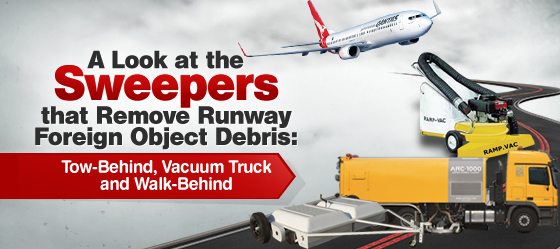
Known as FOD*BOSS, the system grew from a product designed to clean and
groom suburban tennis courts. Aero Sweep director Brook Tozer told Airports that the FOD*BOSS is now
in operation at hundreds of airports worldwide and at 70 airports throughout
Australia and New Zealand.
|

|
|
Any member of an airport
team can operate the FOD*BOSS with a standard road vehicle fitted with
a 50mm tow ball. "It replaces the need for vacuum and sweeper trucks costing
hundreds of thousands of dollars," Tozer says. "Most debris collected by
the FOD*BOSS is well under 50mm, so seeing it from a truck cabin or aircraft
cockpit is almost impossible."
Debris such as
wheel nuts, rivets, stones and luggage hardware is all capable of doing
massive damage to aircraft engines, tyres or blasted by jets seriously
endangering passengers and ground support staff."
Brisbane Airport
At Brisbane Airport runway operations officers conduct runway
inspections four times a day. Extra inspections may also be made at the
request of the control tower after adverse weather, on pilot reports, or
if anything untoward is noted by officers.
Brisbane Airport operations safety and standards manager John McCaffery
told Airports that the major reason for such regular runway checks was
to enable the "safety of aircraft operations, and to ensure the integrity,
reliability and consistency of the runway and taxiway systems."
Two officers, one each side of the runway centreline, generally conduct
inspections, which can take between 20 minutes to over an hour to complete. "There has been a wide variety of objects found during inspections at
Brisbane," McCaffery says. "We've found pieces of aircraft tyre, aircraft
components, bolts, pieces of metal, rocks thrown up by mowers, broken lights,
hats, grass, and soil. The debris is collected or swept and removed by
the operations officers but on occasion the vacuum sweeper is needed to
remove large amounts of debris."
|
|

|
|
Gold Coast Airport
Gold Coast Airport trains operational and ground staff to deal with
FOD.
The most common debris encountered at Gold Coast Airport is associated with
ground handling operations. Baggage tickets, locks, paper and other litter
being the most common.
Ground staff conduct a minimum of two daily inspections plus irregular
inspections as required, while the runways, taxiways and apron are swept
three times a week using a FOD*BOSS.
In addition, senior management, including the technical
services manager and the operations and security manager, complete runway,
taxiway and apron inspections once a week. Gold Coast is also investigating
new technologies, including the Tarsier runway detection radar system,
to assist in the identification of debris and to minimise risks associated
with FOD. |
|
Townsville Airport
Townsville completes runway, taxiway and apron FOD inspections
before every jet landing and takeoff, with the most common debris being
strapping that comes off cargo and baggage locks.
A combination of contract and fulltime staff clear runways and taxiways
weekly with a vacuum sweep, while the apron is cleared once a week with
a FOD*BOSS and vacuumed once a month. Technical staff inspect the runways,
taxiways, and aprons weekly while more detailed inspections are carried
out every six months.
Mt Isa Airport
Like Townsville, Mt Isa conducts runway, taxiway and apron FOD
inspections before every jet landing and takeoff. Due to the geographical
nature of Mt Isa Airport, the most common form of debris found there are
rocks. The airport trains a safety officer in the hazards and risks associated
with FOD.
The main apron is swept using a FOD*BOSS and a sweeper is used on the
taxiway and runway monthly or as required. Technical inspections of the
runway, taxiway and aprons are completed every six months.
Foreign Object Debris is indeed a danger of which airports must be wary,
but with the correct housekeeping can be managed effectively. There are
costs involved in conducting this housekeeping but the costs of not doing
so are inevitably far greater.
Original version of article is online at:
http://www.airportsmag.com/detail_article.cfm?ID=52
Next
Article
|
|
|
|
|
|
|
|
|
|
|